
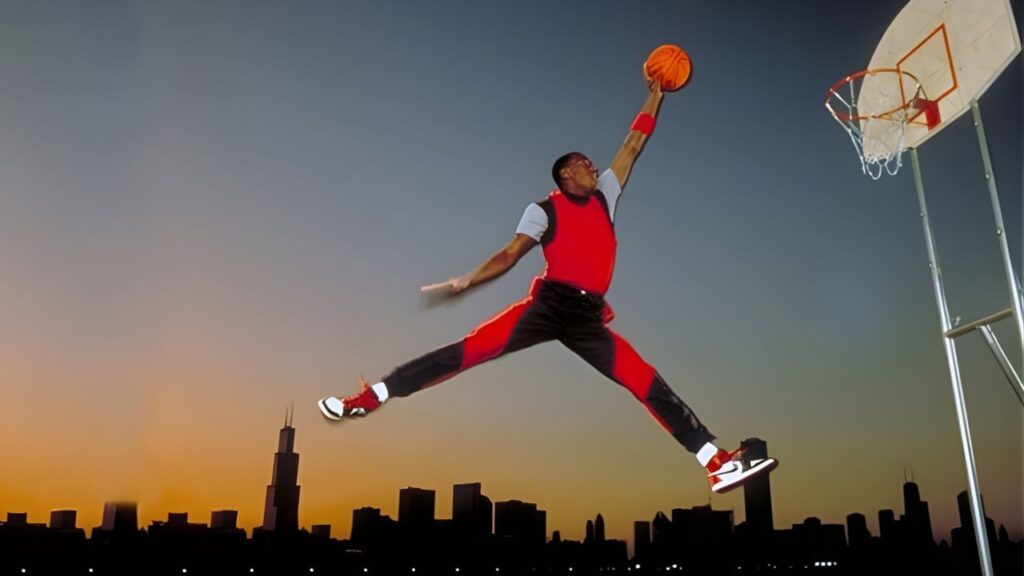
The first time most of America noticed the shoes, they were watching Jordan take apart the Milwaukee Bucks in the 1985 playoffs – 23 points, 10 assists in his first career postseason game, on a Bulls team that had no business being on that floor. He’d already put up 28.2 points, 6.5 rebounds, and 5.9 assists across all 82 regular-season games, shot 51.5 percent from the floor, and won Rookie of the Year going away. Nobody watching him play thought about product margins. But Nike did both, and that was the whole advantage.
The deal was $2.5 million over five years, unprecedented for a rookie who hadn’t played a minute of pro ball. Nike wasn’t even Jordan’s first choice; he wanted Adidas. Nike was coming off a 29 percent drop in earnings that fiscal year, its worst decline in a decade, and was desperate for something that could reattach the brand to a game it was losing ground in. They weren’t just betting on a player. They were betting on whether a court could sell a culture.
The League Tried To Stop It. Nike Wrote Them a Check
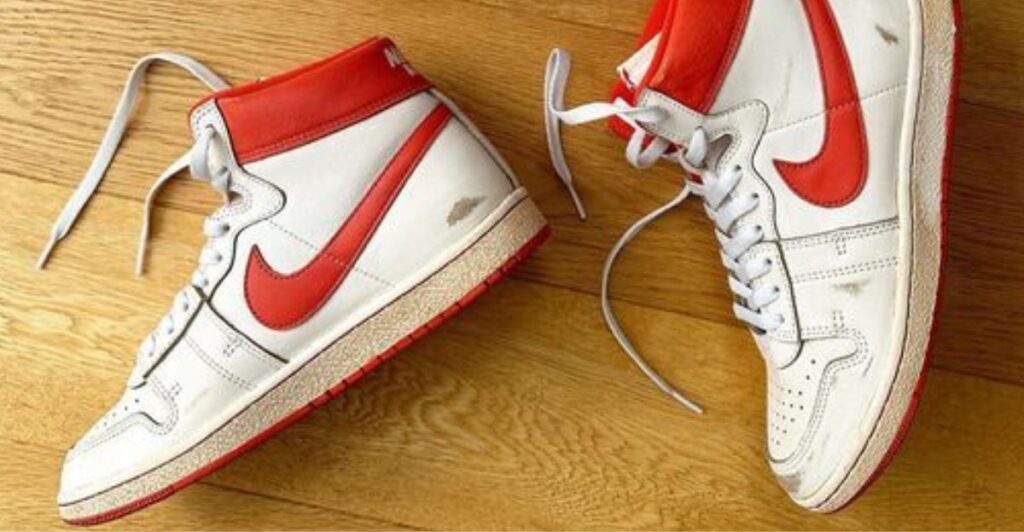
Before the Air Jordan 1 ever hit a retail shelf, Jordan had been wear-testing the Nike Air Ship, a separate shoe in black and red, during the 1984 preseason. The NBA’s uniform rules required footwear to be predominantly white and match teammates’ shoes, and on February 25, 1985, the league formally sent Nike written notice that the black-and-red colorway was in violation. Nike responded by agreeing to pay the $5,000-per-game fine. Voluntarily. Then they built an entire campaign out of it.
The copy ran: “On September 15th, Nike created a revolutionary new basketball shoe. On October 18th, the NBA threw them out of the game.“ The dates referenced the Air Ship controversy, months before the AJ1’s April 1985 public release, but Nike understood that nobody would parse that distinction, and they were right. Nike had projected the Jordan line would earn $3 million over four years. It generated $126 million by the end of its first year on sale … calendar year 1985. The banned shoe wasn’t a liability. It was the whole strategy.
63 Points and a Quote That Sealed Everything
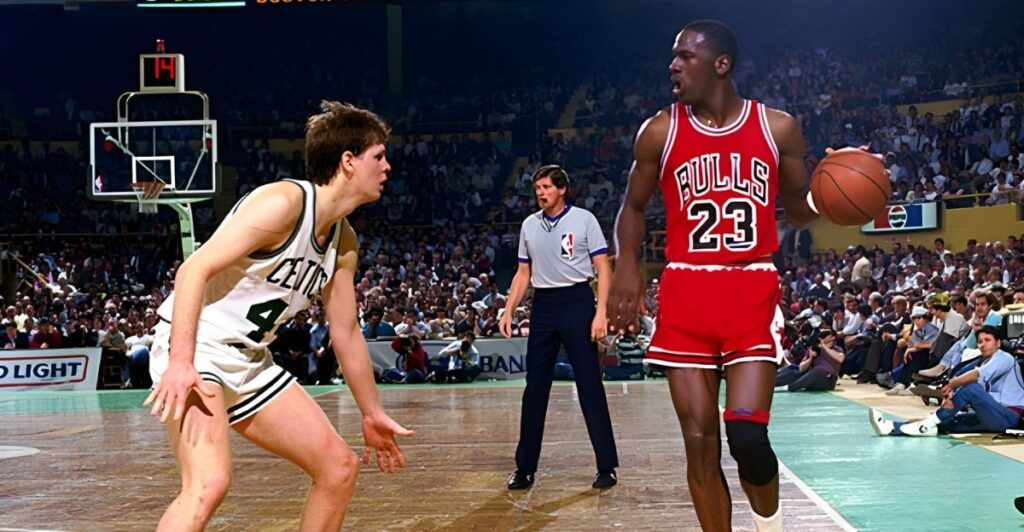
April 20, 1986. Boston Garden. The Celtics had won 67 games that year, went 40-1 at home, and had four Hall of Famers in their starting five: Bird, McHale, Parish, and Dennis Johnson, plus Bill Walton, another HOFer, coming off the bench. The Bulls were the eighth seed. Jordan scored 63 points in 53 minutes across two overtimes, 22 of 41 from the field, 19 of 21 from the line, still the highest-scoring playoff game in NBA history. Chicago lost 135-131. It didn’t matter.
Bird walked off the floor and told reporters, “It’s just God disguised as Michael Jordan. He is the most awesome player in the NBA.” The shoes were on his feet the whole time. Two years later, laced into the Air Jordan 3s, Jordan averaged 35.0 points per game across 82 games, won his first MVP award, and added Defensive Player of the Year in the same season, the only player in NBA history to ever do it. By then, the shoes weren’t just selling; they were carrying the weight of an entirely new kind of athlete mythology.
Tinker Hatfield Kept the Whole Thing Alive

In 1987, the empire nearly cracked open. Peter Moore, who’d designed the first two Air Jordans, left Nike. Jordan was frustrated; the AJ2 had gone too stiff, too fashion-forward, too far from what actually worked on the floor. Competitors were circling with offers. Tinker Hatfield, an architect-turned-designer who’d never built a basketball shoe, was handed the AJ3 project with the renewal on the line. Phil Knight, Hatfield recalled years later, “was pretty well convinced that Michael was gonna leave Nike.”
The meeting to present the shoe was scheduled. Jordan arrived four hours late, straight off a golf course with people actively trying to sign him. Hatfield laid out the AJ3 anyway: mid-cut construction Jordan had specifically requested … elephant-print leather, a visible heel air unit, and a Jumpman silhouette on the tongue pulled from Jordan’s own promotional archive. Jordan started talking colorways on the spot. The six championships, the scoring titles, the global dynasty that followed across the next decade and a half, all of it runs through that room.
$7 Billion. Every Year
Jordan’s NBA salary across his entire playing career totalled roughly $94 million. Jordan Brand generated $7 billion in revenue in Nike’s fiscal year 2024, the company’s strongest-performing division, growing 6 percent while the broader Nike brand stagnated, built entirely around a player who last played in the NBA in 2003. The royalty structure agreed to in 1984 was something no other athlete had secured at that scale, and the compounding across four decades has produced numbers that still don’t feel real.
Six championships. Ten scoring titles. The 63-point game in the Garden. Those are the reasons a new generation of consumers still buys the shoes without having watched a single game of the dynasty that built them. The performances were so unrepeatable that the silhouette carries its weight automatically. Every athlete-turned-brand since has been chasing a version of what Jordan and Nike built, and most of them know that you can copy the colorway, but you can’t copy what earned it.
Sources:
ESPN — A Closer Look at Michael Jordan’s 63-Point Playoff Game
Bleacher Report — ‘God Disguised as Michael Jordan’: When Everything Changed for His Airness
Nike Investor Relations — NIKE, Inc. Reports Fiscal 2024 Fourth Quarter and Full Year Results
Complex Sneakers — The Untold Story Behind Michael Jordan’s Banned Sneakers
CBS News — Founding Father of the Jordan Brand Recalls Nike “Having the Guts” to Bet Big on Michael Jordan 40 Years Ago
New York Times — Case Study: A Onetime Highflier; Nike Struggles to Hit Its Stride Again